The short answer
Acceptance is not a try-out after delivery. It is a written definition of "this machine works", agreed before the order — because the moment the machine lands, the definition gets written by whoever is standing next to the line at two in the morning.
Why this gets skipped
Three pressures push acceptance testing to the end, and all three are understandable:
- The demonstration already happened. A machine that printed perfectly on a sample at a trade fair feels like proof. It is proof that the machine works on that sample, at that speed, on that day.
- Nobody on the buyer's side owns the criteria. Production wants it running, purchasing wants the invoice closed, quality has not been asked. So "works" means "it switched on".
- The supplier is motivated to finish. Not dishonestly — delivery milestones are how they get paid. Which is exactly why the criteria have to exist before that pressure arrives.
The cheapest hour in the whole project
One hour spent writing pass criteria before the order is worth more than a week of argument after installation. It costs nothing, and it converts a conversation about opinions into a conversation about measurements.
FAT and SAT are different jobs
| FAT — factory acceptance | SAT — site acceptance | |
|---|---|---|
| Where | Supplier's plant, before shipment | Your line, after installation |
| What it proves | The machine meets specification as built | The machine works in your process, with your product, your operators, your air and power |
| Material | Your own substrate, sent in advance — not their sample | Production material from the actual line |
| Speed | At specified minimum and maximum | At the speed you will really run, including ramp-up and stop-start |
| Who signs | Your engineer, remotely or on site | Production, quality and maintenance together |
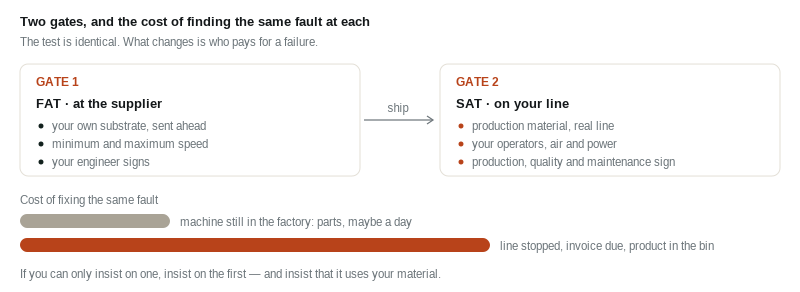
| If it fails | Cheap to fix — the machine has not shipped | Expensive to fix — the line is stopped and the invoice is due |
If you can only insist on one, insist on FAT with your own material. Problems found there cost days; the same problems found at SAT cost weeks and a negotiation.
The test sheet
Four groups. Every row has a pass criterion you can measure — not "acceptable", not "good", but a number or a yes/no.
1 · Mark quality
| Test | How to run it | Pass criterion (set your own) |
|---|---|---|
| Dry rub | Firm pressure with a dry cotton cloth, 20 strokes, same spot | No visible loss of legibility at reading distance |
| Solvent wipe | 70% IPA on a cloth, 10 wipes — repeat with the solvent your process actually uses | Mark still legible; no transfer to the cloth after the third wipe |
| Tape pull | Pressure-sensitive tape applied over the mark, pressed, then pulled at 90° | No more than minor ink transfer; code still decodes |
| 2D code grade | Verify with a calibrated verifier, not a phone app | Grade ≥ C (1.5) is a common purchasing requirement; check what your customer or regulator asks for |
| Contrast | Measured on the same verifier, on the darkest and lightest product you run | Meets the grade above on both — this is where dark compounds fail |
2 · Speed and stability
| Test | How to run it | Pass criterion |
|---|---|---|
| 1,000-code run | Print 1,000 consecutive codes at production speed without intervention | Missing or unreadable characters in fewer than an agreed number of codes — a fraction of a percent, written down |
| Minimum speed | Run at the slowest speed the line will ever use | Code quality unchanged; no smearing or double-print |
| Shift-length run | One full shift without stopping to clean or adjust | No operator intervention required, or a documented interval at which one is |
| Stop-start | 20 stops and restarts, as the line really behaves | First code after each restart is correct — this catches lost position and purge waste |
3 · Data and function
| Test | How to run it | Pass criterion |
|---|---|---|
| Metre mark accuracy | Measure a 100 m run against the printed counter; repeat at low and high speed | Deviation within the tolerance your product standard requires, consistently at both speeds |
| Date rollover | Force a date and lot change, including a month end | Rolls without manual intervention; no duplicate or skipped date |
| Product changeover | Time a switch from one product or code format to another | Under the agreed minutes, done by a trained operator unaided |
| Alarms | Trigger low ink, low solvent, blocked filter, open guard | Each produces a distinct alarm the operator can act on — no generic "fault" |
| Access control | Try to change a parameter as an operator, not an engineer | Restricted as specified, with changes logged |
4 · Site conditions
| Test | How to run it | Pass criterion |
|---|---|---|
| Daily cleaning | Time a full routine clean by an operator | Under the agreed minutes, with the machine back in production |
| Consumable change | Change ink, solvent or ribbon with production waiting | Under the agreed minutes, no spill, no restart error |
| Power and air | Measure actual draw and consumption at the machine | Within the figures in the specification you signed |
| Extraction and fume | Run the worst-case product and observe at the operator position | No perceptible fume or dust at the operator position |
| Noise | Measure at the operator position during production | Within the site limit stated in your own risk assessment |
Set your own numbers in the right-hand column before the order. A criterion added after installation is a preference, not a requirement.
Copy the blank test sheet
CODING LINE ACCEPTANCE — FAT / SAT Site: Date: Signed by: MARK QUALITY Dry rub 20 strokes pass/fail ____ Solvent wipe 10x (70% IPA) pass/fail ____ Tape pull 90 deg pass/fail ____ 2D grade (verifier) measured ____ min ____ Contrast, darkest product measured ____ SPEED & STABILITY 1,000 code run defects ____ max ____ Minimum line speed pass/fail ____ Full shift, no intervention pass/fail ____ 20 stop-starts pass/fail ____ DATA & FUNCTION Metre accuracy @ 100 m error ____ tol ____ Date / lot rollover pass/fail ____ Changeover time minutes ____ max ____ Alarms (ink/solvent/filter) pass/fail ____ Parameter access control pass/fail ____ SITE Daily clean time minutes ____ max ____ Consumable change time minutes ____ max ____ Power / air draw measured ____ Fume at operator position pass/fail ____ Noise at operator position dB ____ max ____
Five things that pass and still fail
| What happened | Why it passed | What it costs later |
|---|---|---|
| Tested on the supplier's sample material | Their sample is chosen to work | Adhesion or contrast fails on your actual compound |
| Only tested at the nominal speed | Nominal is the best case | Missing characters appear at the speed you actually run during peaks |
| Tested for an hour | An hour is not a shift | Printhead drying, ink settling and filter loading all appear later |
| Nobody timed the cleaning | Cleaning is "the operator's job" | Twenty extra minutes per shift is a permanent, unbudgeted labour cost |
| No product changeover test | It was set up for one product | Every subsequent changeover takes twice as long and needs an engineer |
What to put in the contract
Four clauses do most of the work. They are short, and none of them is unusual — a supplier who resists them is telling you something.
01
A pass criterion per line, in the annex
Attach the test sheet as an annex. "Meets specification" is not a criterion; "fewer than 3 defective codes in 1,000 at 250 m/min" is.
02
Payment split at acceptance
A meaningful final payment released on signed SAT. Ten percent is enough to make the conversation happen; without it, the conversation is optional for the supplier.
03
A remedy window, with a date
If SAT fails, a defined period to correct it, and what happens if it is missed — including the right to reject. Undefined remedies are the same as none.
04
Consumables price and third-party permission
Unit price, escalation, minimum volume, and whether third-party consumables are allowed. This is the clause that decides years four and five, and it is almost never in the first draft.
Questions we get
Can I insist on FAT if the machine is a standard model?
Yes, and it is easier than for a custom build — the supplier only has to run your material through a machine that already exists. Offer to send material and attend remotely. A refusal usually means the material is the problem, which is precisely what you wanted to find out before shipping.
What code grade should I demand for 2D codes?
Grade C (1.5) measured with a calibrated verifier is a common purchasing floor; some customers and regulated markets require B or better. The number matters less than agreeing it in writing and measuring it on the worst product you run, not the best.
How long should the stability run be?
One full shift, at production speed, with no intervention. An hour hides printhead drying, ink settling and filter loading — the three things that make a machine feel unreliable in month two.
Do I need a verifier, or will a phone app do?
For acceptance, you need a calibrated verifier if the code is a data carrier. Phone apps read codes; they do not grade them against a standard, so they cannot give you a number to put in a contract.
What if the supplier's engineer disagrees with my result?
This is why the criterion goes in the annex with the method beside it — 20 strokes, 10 wipes, 1,000 codes. Two people following the same written method can compare results; two people arguing about "looks fine" cannot.
Want your test sheet reviewed before you sign?
Send the criteria you intend to attach to the order. We will tell you which rows are unmeasurable, which failure mode they miss, and which one line your supplier will try to remove. No quotation — we do not sell machines.
Send the sheet