The short answer
There is no best coding technology — only the one that survives your substrate, your line speed and your service contract. Answer four questions in order: wall thickness, surface energy, line speed, solvent exposure. Those four eliminate most options before price is ever discussed.
Why this decision goes wrong
Most coding purchases are not decided badly because the buyer lacked information. They are decided badly because the information arrives in a shape that cannot be compared: a demonstration at a trade fair, three quotes with different assumptions, and a consumable price that only makes sense once you know the consumption rate.
Four failure patterns account for most of the bad decisions we see described in public forums and service reports:
- Comparing machines instead of lines. A printer that is fast at 5 mm character height can be slow at 12 mm, and consumption scales with both. Two quotes are only comparable if they state character height, line speed and ink consumption per hour.
- Judging adhesion from a flat coupon. A sample printed on a flat plate and left on a desk tells you nothing about a mark that will be coiled, stretched and wiped.
- Buying the machine, leasing the consumables. The cheapest machine often comes with the most locked consumable contract. Five-year cost lives in that clause, not in the invoice.
- No acceptance test. If "works" is not defined before delivery, it gets defined by whoever is standing next to the line at 2 a.m.
The one habit that prevents all four
Write the acceptance criteria before you request quotes. Character height, line speed, substrate, rub test, solvent wipe, uptime target. Then every quote answers the same question, and the demonstration becomes a check rather than a sales event.
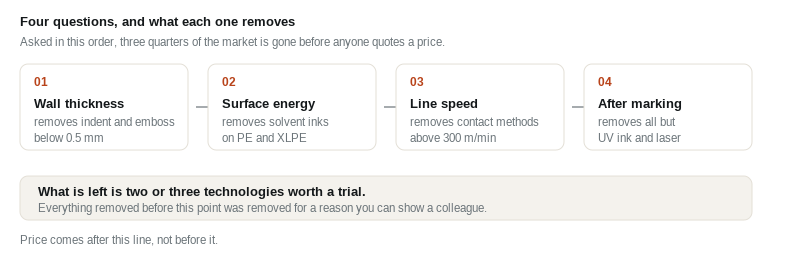
Four questions, in order
The order matters. Answering price first, or automation first, produces a shortlist that has to be thrown away later.
1
How thick is the wall or the part?
Below roughly 0.5 mm of insulation, mechanical methods (indent, emboss) risk cracking and should leave the list. On thin film, laser power has to be chosen to mark without perforating.
Eliminates: indent wheels, some high-power laser options
2
What is the surface energy of the material?
Polyethylene and XLPE sit around 31 mN/m, below what most solvent inks need to wet the surface. PVC is roughly 39 and usually behaves. Measure with a dyne pen on the actual compound — not on the material family name.
Eliminates: standard solvent ink on untreated PE/XLPE
3
How fast does the line actually run?
Use the fastest product you will ever run, not the average. Above roughly 300 m/min, contact methods and slow-cure inks fall out; the choice narrows to non-contact inkjet or laser.
Eliminates: TTO, hot stamp, most contact methods
4
What happens to the product after marking?
Alcohol wipe, oil, freezer, retort, sunlight, abrasion. If the answer includes solvent contact or a washdown, only UV-cured ink or laser reliably survive — and that decision changes the five-year cost far more than the machine price.
Eliminates: dye-based inks, unprotected marks
After four questions you usually have two, occasionally three, viable methods. That is the point at which price becomes a useful input rather than the whole conversation.
The landscape
Five technologies cover almost every industrial case. The table below is the one-page version; each row links to the detailed comparison in this cluster.
| Method | Wins when | Loses when | Dominant cost |
|---|---|---|---|
| CIJ (continuous inkjet) | Curved or uneven surfaces, high speed, frequent product changes | Untreated PE/XLPE; clean-room solvent restrictions | Consumables |
| TIJ (thermal inkjet) | Cartons, labels, high detail, low volume, quick changeover | Non-porous film, solvent environments, long runs | Cartridge replacement |
| TTO (thermal transfer) | Flexible film and laminates, pouch lines, date and batch codes | High speed, stretch film, wrinkled web | Ribbon |
| Laser (CO₂ / fiber / UV) | Permanent marks, no consumables, high volume, thin wall (UV) | Low-contrast on dark compounds; fume extraction needed; high upfront | Capital and downtime |
| PIJ (piezo inkjet) | Large-character cases, porous board, low ink usage | Fine detail, high resolution requirements | Relatively low |
A one-page summary, not a specification. Method choice within each family (ink type, laser wavelength, head count) changes the answer.
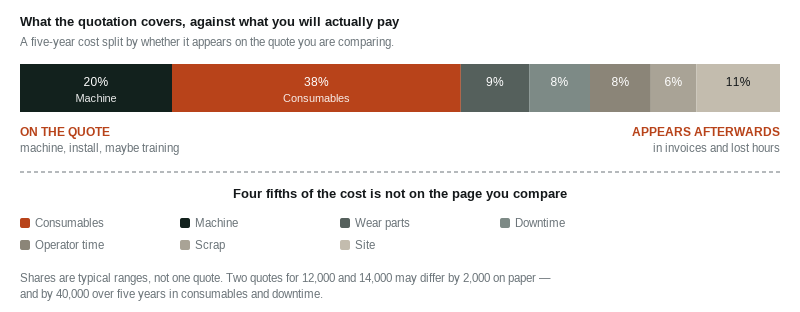
Six cost lines a quote leaves out
Machine price is one line out of seven. Fill this in for each option before comparing — the worksheet is deliberately boring, because boring comparisons are the ones that hold up in a budget meeting.
| Line | How to fill it | Where quotes mislead |
|---|---|---|
| 1. Machine | Purchase or lease, incl. installation and training | Training often "included" as one day on site, not line commissioning |
| 2. Consumables | ml or metres per hour at your character height and speed × running hours × unit price | Quoted at a lower speed or smaller character than you will actually run |
| 3. Wear parts | Printhead, filters, pump, UV lamp, laser source — priced per year, not per lifetime | Lifetime figures given in hours you will never reach |
| 4. Downtime | Stops per year × hours per stop × value of a stopped line | Always omitted; usually the largest single line for laser |
| 5. Scrap and rework | Metres or units lost at start-up and after each stop | Omitted; matters most on short runs with frequent changes |
| 6. Compliance and site | Extraction, solvent storage, compressed air, power, IP rating | Discovered after the purchase order |
Two regularities worth knowing before you fill it in: for CIJ, consumables usually dominate the five-year total; for laser, unplanned downtime usually does. Any comparison that only shows line 1 systematically favours whichever method has the lower sticker price and the higher running cost.
Ask this exact question
"What is the ink consumption in millilitres per hour, at this character height and this line speed?" A supplier who cannot answer it in writing is quoting a machine, not a cost.
Acceptance and contract
The purchase is not finished when the machine arrives. Three things should be settled in writing before that:
- An acceptance test with numbers. Print at minimum and maximum line speed, on the worst substrate you actually run. Check character height, contrast, adhesion (rub and solvent wipe), and code readability if the mark is a data carrier.
- Consumable terms. Unit price, minimum annual volume, price escalation, and whether third-party consumables are permitted. The last one is usually the real negotiation.
- Response time and spares. What counts as a call-out, what parts are held locally, and what happens to the line while you wait. Ask for the number in hours, not "fast".
Questions we get
Should I decide on the technology or on the machine first?
Technology first, always. Machines within one technology differ in build quality and service, but a machine from the wrong technology family cannot be fixed by a better brand. Four questions usually settle the family in under an hour.
Is a cheaper machine with a consumable contract ever the right answer?
Yes, when volume is low and predictable. The contract becomes expensive only when consumption is high or the price escalator is loose. Fill in line 2 with your own consumption, then compare the five-year totals — not the invoices.
How much does line speed actually change the shortlist?
A great deal, and it is the question buyers most often answer with an average instead of a maximum. Use the fastest product you will ever run: methods that work at 120 m/min can fail completely at 400.
Can I trial before buying?
Usually yes, and it is worth asking for a paid trial on your own line with your own substrate for one production week. A trial that costs money is more informative than a demonstration that costs nothing.
What if two methods pass all four questions?
Then the decision moves to the six cost lines and to service response time. At that point, choose the supplier whose acceptance test you can hold them to — that is the only part of the promise that is enforceable.
Everything in this cluster
This guide is the hub. Each page below answers one question in more depth; together they cover the decision from shortlist to signed acceptance.
Technology comparison: CIJ vs TIJ vs TTO vs laser
Comparison
Six criteria across five methods, with the cases where each one gives up.
Total cost of ownership: a worksheet, not a slogan
Cost
The six lines above, worked through with a filled-in example.
Lease or buy a coding machine
Cost
When leasing wins, and the clauses that make it lose.
Buying used coding equipment: a 12-point inspection
Cost
What to measure, what to refuse, and what "refurbished" usually means.
Acceptance testing (FAT/SAT) for a coding line
Contract
The test sheet to bring, and the five checks that catch most problems.
Consumable contracts: the four clauses that decide your cost
Contract
Unit price, minimum volume, escalation, third-party permission.
Character height, speed and consumption
Technical
Why the same machine quotes three different running costs.
Coding on cable extrusion: why ink fails on XLPE
Worked example
The four questions applied to one real substrate, end to end.
Want the shortlist narrowed for your line?
Send four things — substrate, wall thickness or part size, maximum line speed, and what happens to the product after marking. We will reply with the two methods worth trialling, and the reason the others were dropped.
Send the four parameters