The short answer
Ink consumption scales with the area of the characters and linearly with line speed. Double the character height and you roughly quadruple the ink; double the line speed and you double it again. Any figure quoted in millilitres per hour without stating height and speed is not a measurement, it is a hope.
This is the single most common source of disagreement between what a supplier promises and what a factory measures. Both numbers can be honest and still differ by a factor of four, because they were taken at different character heights.
Why height matters more than price
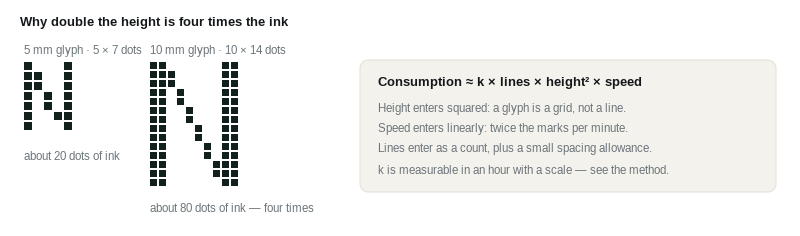
A dot-matrix character is built from dots laid out on a grid. A 5 mm character might be 5 dots wide by 7 tall; a 10 mm character is 10 by 14. Four times the dots, four times the ink — a square law, not a linear one.
Height doubles
Dots per character roughly quadruple; ink roughly quadruples
Lines double
Ink roughly doubles (plus a small allowance for line spacing)
Speed doubles
Ink roughly doubles — twice as many characters per minute
Character width changes
Ink scales with width too; a condensed font uses less than a wide one
So the practical form of the calculation is:
Consumption ≈ k × lines × height² × speed
Where k is a machine-and-font constant you can measure in an hour (below). Height in millimetres, speed in metres or characters per minute, lines as a count. Everything scales predictably once k is known — which is why one careful measurement beats any number from a brochure.
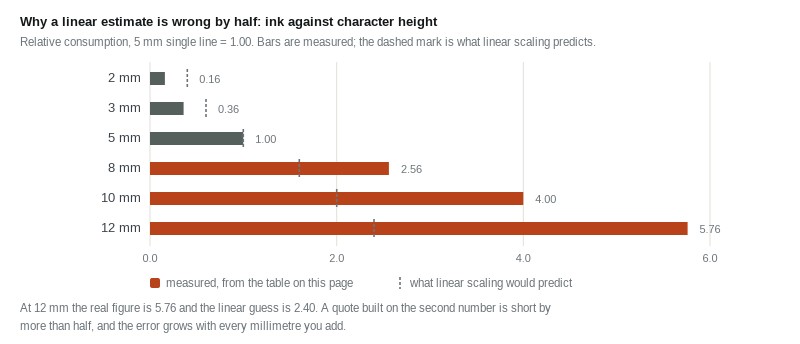
Relative consumption
The table below is geometry, not measurement: it shows how the numbers move relative to a 5 mm single-line code, which is set at 1.00. Use it to see the shape of the problem, then measure your own constant.
| Character height | 1 line | 2 lines | 3 lines | vs 5 mm single line |
|---|---|---|---|---|
| 2 mm | 0.16 | 0.32 | 0.48 | a sixth of the ink |
| 3 mm | 0.36 | 0.72 | 1.08 | about a third |
| 5 mm | 1.00 | 2.00 | 3.00 | reference |
| 8 mm | 2.56 | 5.12 | 7.68 | two and a half times |
| 10 mm | 4.00 | 8.00 | 12.00 | four times |
| 12 mm | 5.76 | 11.52 | 17.28 | nearly six times |
Geometric estimate assuming square-scaling dot grids and equal line spacing. Real machines differ slightly by font and resolution — which is exactly why the measurement below exists.
Two consequences follow immediately. A quote prepared at 5 mm for a customer who will actually run 10 mm two lines is understated by a factor of eight. And a site that reduces from 10 mm to 5 mm saves roughly three quarters of its ink — which is why character height is a specification decision, not an aesthetic one.
Measure it yourself in an hour
You do not need a laboratory. You need a scale accurate to a gram, a fixed production run, and the discipline to change only one variable.
01
Weigh the ink supply
Weigh the ink cartridge or reservoir before the test, on a scale accurate to a gram. Record the starting weight and the ambient temperature — viscosity and evaporation both move with temperature.
02
Run 1,000 codes at production settings
Use the real character height, line count and line speed. Do not average: 1,000 consecutive codes at the speed you actually run. Note the elapsed time.
03
Weigh again and divide
Weight difference in grams ÷ 1,000 = grams per code. Multiply by codes per hour for grams per hour. Divide by ink density (roughly 0.9–1.0 g/ml for most solvent inks) for millilitres.
04
Repeat at one other height
Run the same test at double the character height. If your consumption does not roughly quadruple, something else is changing — usually the font, the line count, or a resolution setting.
Do not forget the solvent
Weighing the ink tells you half the story on a CIJ machine, because solvent evaporates continuously and is topped up separately. Track solvent consumption over the same period from the top-up log, or measure it the same way. On many installations solvent is the larger volume of the two.
Three ways the sum goes wrong
| Mistake | What it does to the answer | How to avoid it |
|---|---|---|
| Scaling linearly with height | Understates a doubling by a factor of two | Scale with height squared; then check against a real measurement |
| Ignoring line count and font | Two lines at the same height is double, not the same | Count lines separately, and use the font the machine will actually run |
| Using an average speed | A line that peaks at 300 m/min but averages 120 consumes far more than the average suggests | Multiply by the speed you actually run, including peaks |
Once you have your own constant, the commercial conversations get much shorter: the per-litre price becomes a multiplier rather than a mystery, and the difference between two quotes can be expressed as cost per thousand marks on your own line.
Questions we get
Why is the supplier's consumption figure so much lower than mine?
Almost always a different test condition: smaller characters, fewer lines, lower speed, or a laboratory ink at a different temperature. Ask what height, how many lines and what speed the figure was taken at. If the answer is vague, the figure is not usable for budgeting.
Does a narrower font really save ink?
Yes, in proportion to the width. A condensed font can use a fifth less ink than a wide one at the same height, which matters on high-volume lines. The trade-off is legibility and code readability — verify the mark still passes your quality checks before switching.
How do I compare inkjet consumption with laser?
Laser has no consumable per mark, so the comparison is not millilitres against nothing — it is consumables against electricity, extraction and source replacement over the same output. Put both into the seven-line worksheet on the same production assumption.
Can I put consumption into a contract?
Yes, and you should: "ink and solvent consumption at 5 mm, two lines, 250 m/min shall not exceed X ml per running hour when measured by the weighing method in Annex B". A figure with a method attached is enforceable; a figure alone is marketing.
Does print quality change consumption?
It can. Higher resolution or bold fonts lay down more ink per character, and degraded printheads sometimes need more ink to produce the same contrast. If consumption rises without a settings change, suspect the head before the ink.
Two quotes, two consumption figures, no way to compare?
Send the height, line count and speed you actually run, plus both consumption figures. We will convert them to grams per thousand marks so they can be compared. No quotation, we do not sell machines.
Send the three settings