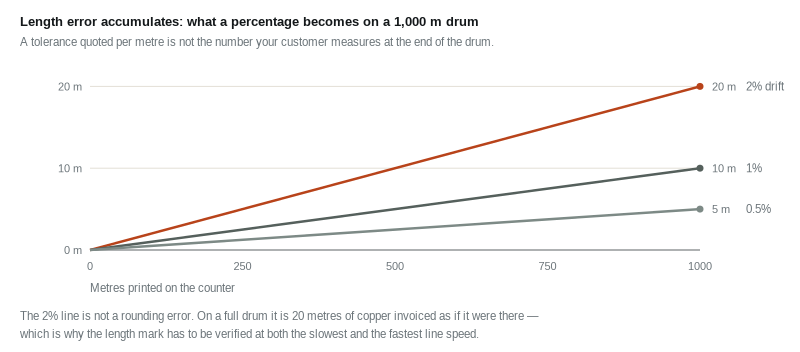
Cable is one of the few products where the mark is legally part of the product. A length number that drifts by two percent is not a cosmetic defect — it is a claim about how much copper the customer received. That is why coding on an extrusion line gets harder the closer you look at it.
This guide covers the four methods used on extrusion lines, why the same ink that works on PVC fails on XLPE, and which cost lines a quote usually leaves out.
What the mark has to survive
Before comparing technologies, list what the mark goes through. On a typical cable line, five things happen after printing:
- Coiling and uncoiling. The printed surface rubs against itself under tension. Ink that looks perfect on the take-up reel can be unreadable after one drum.
- Handling and abrasion. Cable is dragged, bent over sheaves, and pulled through conduit. Marks must hold through mechanical contact, not just handling gloves.
- Oil and solvent contact. Especially in industrial and automotive routes, insulation gets wiped with cutting fluid, alcohol, or cleaning agents.
- UV and weather. Outdoor and overhead cable may sit in sunlight for years. Many dye-based inks fade; pigment-based ones hold better.
- Line speed. Small-diameter lines commonly run from a few hundred to over a thousand metres per minute. Contact methods and slow-curing inks simply cannot keep up at the top of that range.
Practical consequence
Two inks with the same colour and the same “for PE” label can behave completely differently after coiling. Ask for a sample printed on your insulation, coiled, and rubbed — not a sample on a flat coupon.
Why ink fails on PE and XLPE
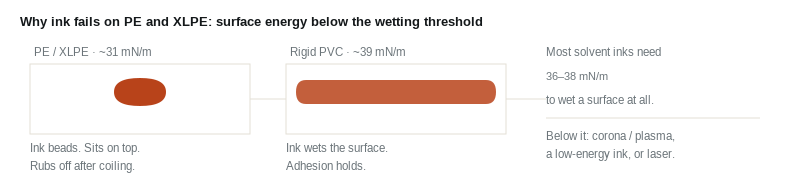
Almost all adhesion problems on cable come down to one number: surface energy. For an ink to wet a surface and stay there, the surface energy has to be higher than the ink’s surface tension. Most solvent-based coding inks sit around 36–38 mN/m.
Polyethylene (PE)
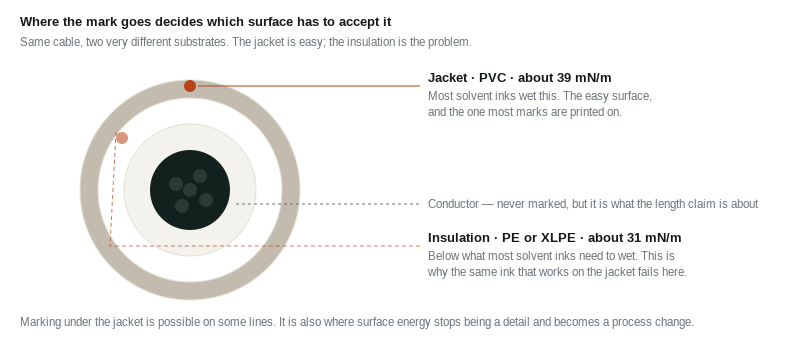
roughly 31 mN/m — below the ink’s wetting threshold
XLPE (cross-linked PE)
similar to PE; cross-linking does not raise surface energy
Rigid PVC
roughly 39 mN/m — usually wets without treatment
LSZH compounds
varies widely by filler; test, do not assume
So on PE and XLPE, the ink does not spread evenly. It beads, dries as a film sitting on the surface rather than bonded to it, and rubs off at the first contact. There are four ways the industry deals with this:
- Surface treatment. Corona or plasma discharge raises PE to about 38–42 mN/m. It works, but the effect decays with time and handling — print close to the treatment station, not after a day in storage.
- Ink formulated for low-energy surfaces. Some solvent inks use aggressive solvents that partially swell the surface. They adhere better, and they also attack some printhead components and smell strongly on the line — a real operator complaint.
- UV-curable ink. Cured instantly by a UV lamp on the head. The result is a cross-linked film with good chemical and abrasion resistance. This is the usual answer for PE and XLPE where the mark must survive solvent wiping, at the cost of a lamp, higher ink price, and a curing system to maintain.
- No ink at all. Laser or mechanical indent. The mark is in the material, so adhesion is not a factor — different problems replace this one.
Four ways to mark cable
| Method | On PE / XLPE | Line speed | Consumables | Typical failure |
|---|---|---|---|---|
| CIJ, standard solvent ink | Weak without treatment; beads and rubs off | High — good match for small-diameter lines | Ink + solvent, continuous | Adhesion loss after coiling |
| CIJ, UV-curable ink | Good; cross-linked film resists wiping | High | Ink + UV lamp power | Lamp ageing → under-cured, tacky mark |
| Laser (CO₂ / UV) | Permanent; UV avoids burning thin insulation | High | None; electricity and extraction | Contrast too low, or damage to thin wall |
| Indent / emboss wheel | Permanent, mechanical | Low to medium | Wheel wear parts | Cracks thin insulation; text limited |
Typical behaviour, not a specification. CO₂ marking on PVC releases chlorine-bearing fumes and needs extraction; UV laser is usually preferred on thin wall.
A decision path
Four questions, in this order. Most wrong purchases come from answering them out of order.
1. Wall thickness
Below roughly 0.5 mm, drop indent from the list — cracking risk is real.
2. Surface energy
PE or XLPE without in-line treatment → uv-curable CIJ or laser, not standard solvent ink.
3. Line speed
Above roughly 300 m/min, contact methods and slow-cure inks lose; this is CIJ or laser territory.
4. Solvent exposure
If the cable is wiped with alcohol or oil downstream, only UV-cured ink or laser pass.
If all four answers point to “laser”, check the next question before committing: does the mark need to be high-contrast on a dark compound? Laser on black PE often produces low-contrast marks that pass a human eye but fail a vision system. CIJ with white or light ink may still be the right answer.
Cost: the part quotes omit
Machine price is the least useful number in a comparison. A working worksheet has six lines:
Consumables
ink and solvent consumption per hour × running hours × unit price
Wear parts
printhead, filters, pump, UV lamp or laser tube life, priced per year
Downtime
unplanned stops per year × hours per stop × value of a stopped line
Yield loss
metres scrapped at start-up and after each stop
Operator time
daily cleaning, ink top-up, parameter changes
Compliance cost
extraction, fume handling, solvent storage — often the deciding line for laser
Two observations that hold across most projects: consumables dominate the five-year cost of CIJ, and downtime dominates the five-year cost of laser. Comparing only machine price systematically favours whichever method has the lower sticker and the higher running cost.
Ask for this before signing
Ink consumption at your line speed and character height, in ml per hour. Not “low consumption”. Consumption scales with character height and speed, and a quote built on a slower line will not hold.
Failure modes, and what they usually mean
| Symptom | Most common cause | Check first |
|---|---|---|
| Mark smears when rubbed | Insufficient cure or wrong ink for the substrate | UV lamp hours; ink batch; surface energy of the compound |
| Characters missing at speed | Charge or deflection drift, not software | Printhead alignment; solvent ratio; nozzle partial clog |
| Meter count drifts | Encoder coupling or wheel slip | Encoder mounting; cable slip at the capstan |
| Mark fades over months | Dye-based ink under UV | Switch to pigment-based or laser |
| Ink will not adhere at all | Surface energy below threshold | Dyne test pen on the actual compound |
What the mark must carry
Requirements differ by market and by cable standard, but most cable marking schemes ask for the same three things, plus one:
- A sequential length, accurate enough to be trusted for invoicing.
- The cable designation — conductor size, insulation type, voltage class.
- Manufacturer identification — name, trade mark, or registered code.
- Where applicable, certification marks and a batch or traceability code.
Two practical notes. First, conductive or light-coloured inks may be restricted on some compounds; check before specifying colour. Second, if the mark is also a traceability code, the reading system (not the printing system) sets the quality bar — test the code after coiling, under the actual lighting of the inspection point.
Questions we get
Can I keep my existing CIJ and just change the ink?
Sometimes. If the problem is adhesion on PE or XLPE, a UV-curable ink needs a UV curing head on the printer — it is not a drop-in cartridge change. If the problem is fading, switching to a pigment-based solvent ink may be enough. Test on coiled, rubbed samples either way.
Is laser always more expensive to run?
No. Laser has no ink, so its running cost is electricity, extraction and tube or source replacement. On high-volume lines with long runs, laser frequently wins on five-year cost. On lines with frequent product changes and short runs, CIJ usually wins because there are no per-product parameters to re-qualify.
Do I need corona treatment if I use UV-curable ink?
Not always — UV inks are formulated for lower surface energy than standard solvent inks. But “not always” is not “never”. Run a dyne test on the compound and print a trial; the answer depends on the specific compound and filler package, especially with LSZH.
How do I know the length mark is accurate enough?
Compare a measured 100 m run against the printed counter, repeated at low and high line speed. Drift that changes with speed points to encoder or slip; drift that is constant points to wheel diameter or calibration.
What about printing on the conductor itself?
That is a different problem — usually solved with colour coding, printing on the insulation, or a binder tape. Coding directly on bare copper is not a marking application; it is a metallurgical one.
Need this compared on your compound?
Send the insulation type, wall thickness, line speed and character height, and we will tell you which two methods are worth trialling — including the case where neither of ours is the answer.
Request a comparison