The short answer
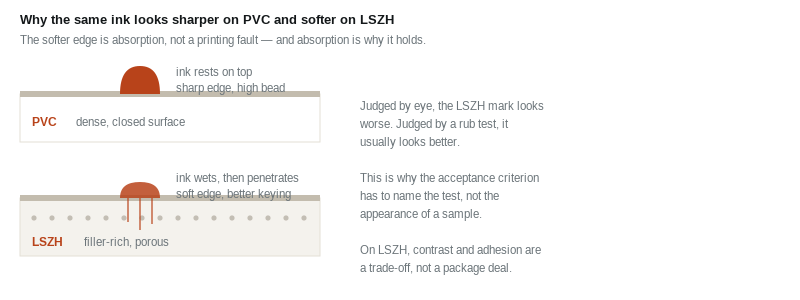
LSZH compounds are loaded with inorganic fillers — often more than half the formulation by weight — to suppress smoke and halogen release. Those fillers make the surface porous and ink-absorbent, which produces a mark that looks softer and less crisp than on PVC, while often adhering better. The mistake is judging the mark by how it looks on the day it is printed.
This is the one material where the usual quality instinct — sharp edges mean a good mark — points the wrong way.
What LSZH actually is
Low smoke zero halogen is a family, not a compound. The common base is a polyolefin — PE or EVA — with a filler system, typically aluminium hydroxide or magnesium hydroxide, at loadings that can exceed 60% by weight. The filler releases water vapour when heated, which cools the flame and dilutes combustible gases; that is the mechanism, and it is why the loading is so high.
Base polymer
PE, EVA or a blend — low surface energy, like the material it replaces
Filler
ATH or MDH, often 55–65% by weight
Surface
Micro-rough, mildly porous, slightly chalky to the touch
Mechanical
Softer and more abrasion-sensitive than PVC
What that means for ink
Wetting is harder; absorption is easier; the two effects compete
Why the surface behaves oddly
Two things happen at once, and they pull in opposite directions.
Wetting is harder. The base polymer is a polyolefin, so the surface energy is low — in the same range that makes plain PE difficult. A solvent ink that needs 36–38 mN/m may not spread cleanly.
Absorption is easier. The filler creates microscopic porosity. Once the ink does wet, it can penetrate rather than sit on top, which improves mechanical keying and makes the mark resistant to abrasion.
The visible result is a mark with softer edges and lower contrast, which looks like a printing failure and behaves like a good bond. Buyers who judge by appearance reject the better mark; buyers who judge by rub testing accept it.
The trade-off
| If the customer judges by | What to optimise | What you give up |
|---|---|---|
| Appearance at goods-in | Higher contrast ink, larger character height, slower line speed or a surface treatment | Some abrasion resistance, and often cost per metre |
| Survival after installation | Absorbing ink, moderate contrast, verified by rub and wipe rather than by eye | Crisp edges — the mark will look softer from day one |
| Both | Laser, if the compound absorbs the wavelength and the layer is not the dielectric | Consumable cost goes away, but qualification work arrives |
The decision belongs in the purchase specification, not in the printhead settings. Write down which of the three the customer actually checks — and if nobody knows, find out before the first drum ships.
Which method suits which result
- CIJ with an absorbing ink. The usual choice. Expect softer edges and good rub resistance; verify both, because the two are not correlated with each other.
- Laser. Works well on many LSZH jackets because the filler responds to the beam and produces a light or dark mark without ink. Depth control matters, and the same dielectric caution applies as anywhere else.
- Indent. Possible on thicker walls, but filled compounds are abrasive and wear dies faster. Also see indent marking for the wall-thickness limit.
- Thermal transfer. Rare on extrusion lines, but used on finished LSZH goods where a ribbon can be applied to a flat surface.
Testing it properly
Standard adhesion tests work, with two adjustments for LSZH:
- Do not judge contrast before absorption is complete. Some inks continue to absorb for minutes after printing. Assess after the cable has cooled and at least a few minutes have passed — not at the printhead.
- Test abrasion separately from adhesion. LSZH is softer than PVC, so a mark can be well bonded and still wear off because the surrounding compound wears away with it. Use a rub test for adhesion and an abrasion test for survival.
- Test the actual compound. "LSZH" covers formulations from 50% to 65% filler with different bases. A result on one supplier's compound says nothing about another's.
The sentence to put in the specification
"Mark shall remain legible after 20 strokes of a dry cotton cloth and 10 wipes with 70% IPA, assessed after the cable has cooled to ambient, on production compound." The "after cooling" clause is the one that prevents a dispute about a mark that looked fine on the line and faded on the drum.
Questions we get
Why does my LSZH mark look worse than the sample I approved?
Two common reasons: the sample was printed on a different compound, or it was assessed before absorption finished. Ask for the print to be judged after cooling, on production material, and compare under the same lighting.
Can I use the same ink on LSZH as on PVC?
Sometimes, but it is a coincidence rather than a rule. The base polymer is a polyolefin, so adhesion is harder; the filler gives absorption that can compensate. Test on the actual compound — the family name hides large differences.
Does laser mark LSZH well?
Often yes, and it is a common choice on LSZH jackets because the filler responds to the beam. What must be checked is depth and, if the layer is a dielectric, the electrical qualification — the same caution as any laser on cable.
Is a softer mark on LSZH a defect?
Not necessarily. Softer edges usually mean the ink has absorbed, which is good for durability. What matters is legibility at reading distance and survival in the rub and abrasion tests, not edge sharpness.
Why do dies wear faster on LSZH?
The filler is abrasive. Aluminium hydroxide and magnesium hydroxide are harder than the polymer matrix, so an indent die or a guide in contact with the surface wears faster than it would on unfilled PE.
Next in this thread
How LSZH fits into the three constraints, and why surface comes first.