The short answer
Cable is the one product where the mark is part of the specification. A date code that fades is a cosmetic defect; a length number that drifts is a false statement about how much copper the customer received. So the question is never "which printer" — it is which of three constraints binds first: the surface you have to wet, the speed you have to keep up with, and the length accuracy you are willing to defend.
Everything on this page follows from that. If you already know your substrate and your line speed, skip to the decision path. If you are still comparing machines, start with the constraints — most cable marking projects fail at the first one, not at the purchase order.
Why cable is different
Three things make cable harder than cartons, bottles or film.
The mark is a measurement. A metre mark is not decoration; it is how the customer knows what they bought. When a drum is invoiced, the length printed on it is the quantity. An error of 2% on a 1,000 m drum is 20 metres of copper — real money, and a claim waiting to happen.
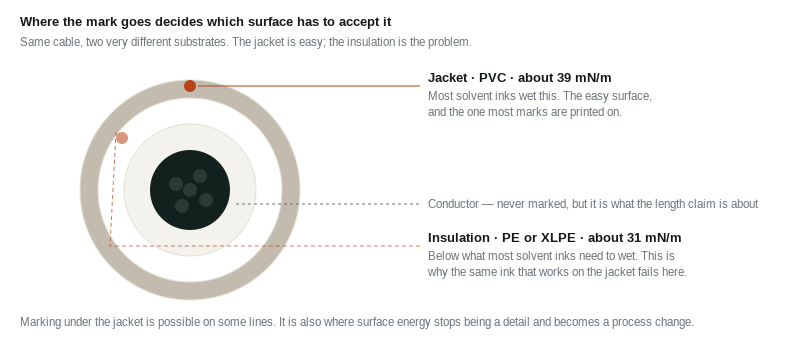
The substrate is chosen for electrical performance, not for printing. Polyethylene and XLPE sit around 31 mN/m surface energy, below what most solvent inks need to wet. The material is doing its job perfectly; the ink is the intruder. This is covered in detail in why ink fails on XLPE.
The product moves fast and never stops. Small-diameter lines commonly run from a few hundred to over a thousand metres per minute. At 800 m/min the cable travels 13 metres every second; a one-millisecond delay in the print trigger is a 13 mm error in where the character lands.
Three constraints, in order
Ask them in this order. Answering cost or automation first produces a shortlist you will throw away.
| Constraint | The question | What it removes |
|---|---|---|
| 1 · Surface | What is the outer layer, and what is its surface energy? | Solvent inks on untreated PE/XLPE. Anything that needs a dyne level you do not have. |
| 2 · Speed | What is the fastest you will ever run, not the average? | Contact methods above roughly 300 m/min. Slow-cure inks anywhere near the top of the range. |
| 3 · Length | Who measures the metre mark, and to what tolerance? | Any trigger source without an encoder. Systems that cannot compensate for print delay. |
Each constraint removes methods, not brands. By the third question the shortlist is usually two options, and the comparison becomes about service and consumables rather than technology.
Where each method fits
| Method | Usually chosen when | Fails when |
|---|---|---|
| Indent / emboss wheel | Thick insulation, permanent mark wanted, no consumables, low content variability | Wall under about 0.5 mm; content must change per batch; high speed |
| CIJ (continuous inkjet) | Non-contact, high speed, variable data, jacket or insulation with treatment | Untreated PE/XLPE without pretreatment; solvent handling constraints |
| Laser | Permanent, no consumable, jacket marking, low-voltage products | Insulation on medium and high voltage cable; thin walls; light-coloured compounds |
| Thermal transfer / hot stamp | Rarely on extrusion lines; occasional on finished goods or heat-shrink | Line speed; contact pressure on soft insulation |
"Fails when" is the useful column. Most bad purchases on cable lines come from choosing on the first column and discovering the third afterwards.
What failure costs on a cable line
Cable changes the arithmetic of scrap. On a bottling line a rejected unit costs a bottle; on a cable line a rejected section costs the copper inside it, multiplied by however long it takes to notice.
Three failure modes dominate, and each has a different signature:
- Adhesion loss. The mark passes the rub test at the start of the run and fails two hours later, because the printhead has warmed or the line has sped up. Cost: metres scrapped, or a customer complaint six weeks later.
- Length drift. The metre count accumulates error silently. Nothing looks wrong until someone measures a drum. Cost: the whole drum, priced as if the missing metres were there.
- Legibility failure after processing. The mark survives extrusion and fails after coiling, or after the cable is pulled through a duct. Cost: re-marking is impossible on installed cable.
The one number to put in the purchase order
Not "legible mark". Write: "the mark shall remain legible after 20 strokes of a dry cotton cloth at firm pressure and 10 wipes with 70% IPA, at minimum and maximum line speed, on production material." A criterion with a method attached can be enforced; "good adhesion" cannot.
The decision path
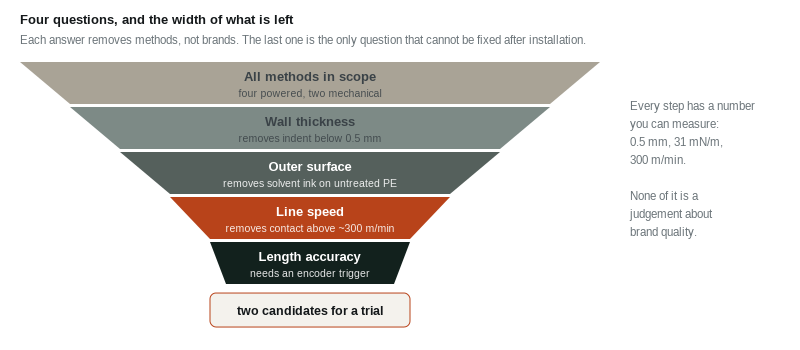
Four questions, and what each removes. This is the same sequence used in the general selection guide, applied to cable specifically.
1
Is the wall thick enough to indent?
Below about 0.5 mm of insulation, mechanical marking risks cracking and leaves the list. On thin film, laser power has to be chosen to mark without perforating.
2
What is on the outside?
PVC jacket around 39 mN/m takes most solvent inks. PE or XLPE at 31 needs pretreatment, a different ink, or a non-ink method. Measure with a dyne pen, not from a datasheet.
3
What is the fastest you will run?
Above roughly 300 m/min, contact methods and slow-cure inks fall out. The choice narrows to non-contact inkjet or laser.
4
Who measures the length, and to what tolerance?
If the metre mark is invoiced, the trigger needs an encoder and the system needs delay compensation. This is the constraint that decides between two otherwise equal machines.
Accepting a line
Two groups of tests matter on cable, and they are usually run at the wrong moment. Full detail is in acceptance testing; the cable-specific parts are:
Metre mark accuracy
Measure a 100 m run against the printed counter, at minimum and maximum speed
Adhesion
Dry rub 20 strokes, 70% IPA 10 wipes, on production material, not a sample
Stability
1,000 consecutive codes at production speed without intervention
Stop-start
20 stops and restarts — the first code after each restart must be correct
Changeover
Time a batch and length change, done by an operator unaided
The metre mark test is the one people skip, because it needs a tape measure and a full drum. It is also the only test a customer will repeat.
On standards, the mark has to carry more than most buyers expect — manufacturer, size, voltage class, year, and often a certification body. What each market requires is set out in what the mark must carry.
Questions we get
Do I need to mark the insulation, or only the jacket?
Almost always the jacket. Insulation marking happens on some lines but requires either pretreatment or a laser whose effect on the electrical properties has been qualified. If a customer specifies marking under the jacket, treat it as an engineering change, not a printer change.
Can one printer do both the metre mark and the batch code?
Yes, and it is the normal configuration: one printhead, one message containing both a sequential field and fixed text. The constraint is not the printer but the trigger — the sequential field needs an encoder signal, not a timer.
What line speed is too fast?
There is no single number. Above roughly 300 m/min contact methods drop out; above about 600 m/min the limiting factor usually becomes encoder resolution and print delay compensation rather than the printhead itself. Ask for the speed the vendor's figure was measured at, and at what character height.
Is laser cheaper than inkjet over five years?
On a jacket, often yes, because there is no consumable. On insulation it is usually not an option at all. Compare on the same output with the seven-line worksheet rather than on machine price.
How often does the metre mark need calibrating?
Check it at every speed change and at the start of each shift; formally verify it weekly against a measured run. Drift is slow and silent, so the only defence is a scheduled measurement rather than an alarm.
Next in this thread
Surface energy, dyne testing, and the four ways to make ink stay on polyethylene.