The short answer
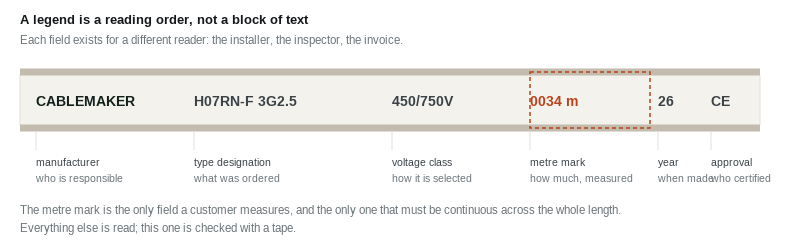
A cable legend is not a label — it is the product's legal description, and getting a field wrong is a non-conformity rather than a printing defect. The content is set by the standard the cable is made to, the space is set by the cable diameter, and the one field customers physically check is the metre mark.
The practical difficulty is that the requirement is a list, the space is a cylinder, and the list grows every time a market is added. Most marking problems on cable are layout problems disguised as printer problems.
The fields, and who asks for them
| Field | Why it is there | Common mistake |
|---|---|---|
| Manufacturer name or mark | Traceability to the responsible party | Trademark registered in one market only |
| Product designation | The type the customer ordered, in the standard's nomenclature | Using the internal product code instead |
| Voltage class | Safety information; also how the cable is selected | Omitting U0/U where the standard requires both |
| Conductor size and core count | What is inside, in mm² or AWG | Imperial and metric mixed on one legend |
| Metre mark | Quantity, and the basis of invoicing | Sequence that resets per drum instead of continuous |
| Year of manufacture | Ageing, warranty, and installation records | Printed once at the start of the run and never updated |
| Certification mark | Third-party approval, where the market requires it | Applied before the approval is actually granted |
The list is indicative, not a substitute for the standard your product is made to. Which fields are mandatory, and in what wording, is set by that standard and by the customer's specification.
How markets differ
| Market | Typical basis | What changes in practice |
|---|---|---|
| Europe / IEC | IEC 60227 (low voltage), IEC 60502 (medium and high) | Designation codes are compact but rigid; U0/U required |
| North America | UL 44, UL 83 and related | AWG sizes, temperature rating, UL file reference |
| China | GB/T 5023 and the CCC scheme | CCC mark and Chinese-language designation on some products |
A cable made for two markets usually carries two legends, or one combined legend with both designations. Both approaches increase the character count, which is the next problem.
The one field that gets measured
Everything else on the legend is checked by reading. The metre mark is checked by measuring, and that changes its status: it is the only field where being wrong produces a quantitative claim.
Two properties make it different from the rest of the legend:
- It must be continuous across the whole length, not reset per drum. A sequence that restarts is useless for cutting to length.
- It must be sequential, which rules out any fixed method — see why a die cannot do it.
The accuracy question is separate and covered in why the metre mark drifts. For the legend itself, the requirement is simpler: the number must be present, legible, and in sequence.
Fitting it on the cable
This is where most legends are compromised. The arithmetic is unforgiving:
Available circumference
π × diameter — on a 12 mm cable, about 38 mm of usable width
Character width at 1.5 mm height
Roughly 1.0–1.2 mm, depending on font
Characters per line
About 30 on a 12 mm cable, less after margins
Lines available
Two or three, if the character height stays legible
Two consequences follow. First, the legend often has to run along the cable as a single line rather than around it, which changes the print layout entirely. Second, adding a market means either reducing character height or accepting a longer repeat distance — and a longer repeat means more cable between identical legends, which some customers specify against.
Check this before the printer is chosen
Write out the full legend for every market you sell into, count the characters, and divide by the characters-per-line your chosen height gives you. If it does not fit, no printer will fix it — the decision is about which fields you are required to carry, and that is a conversation with your customer, not your supplier.
What an auditor checks
Three things, in this order, and the first one is the one that fails:
- Presence and wording of the mandatory fields. Not "similar to" — the designation has to match the standard's nomenclature.
- Legibility after handling. On a drum, not on a sample. Marks that fail here usually fail because of adhesion on the compound, not because of print quality.
- Metre mark continuity and accuracy. Continuity is checked by reading across a joint; accuracy by measuring.
An auditor will also ask how you control it, which is why a written criterion with a method attached is worth more than a good-looking sample.
Questions we get
Is the metre mark legally required on all cable?
On most cable sold by length it is required or contractually specified, because it is how quantity is established. The exact requirement depends on the standard and the market — check the standard your product is made to rather than assuming.
Can the legend be printed on the insulation instead of the jacket?
Sometimes, but it is a different engineering problem — see why ink fails on XLPE. Most legends are printed on the jacket, after the final extrusion.
How many characters can fit on a small cable?
On a 12 mm cable, roughly 30 characters per line at 1.5 mm height, less with margins. On thin cables the legend usually runs along the axis rather than around it, which changes the print layout.
What happens if one field is missing?
It is a non-conformity, not a cosmetic issue. In practice it means the drum cannot be shipped to that market, and re-marking installed cable is not possible — which is why the legend is checked before the run, not after.
Do certification marks need to be printed by the cable maker?
Where the scheme requires the mark on the product, yes, and it must not be applied before the approval exists. The wording and the artwork are usually controlled by the certification body, so the print layout has to accommodate their file.
Next in this thread
Where the legend fits into the production constraints.