The short answer
Indent marking has no consumable, no ink, no solvent and no mark that can be removed. That combination is still unmatched, which is why wheels are still running on lines that could afford anything. What ends an indent installation is almost never cost — it is the arrival of variable data, or a move to thinner walls.
Every few years the method is declared obsolete and every few years it survives, because the two things buyers say they want most — permanence and zero consumable — are exactly what a wheel provides.
Why it survives
Consumable
None. No ink, no solvent, no ribbon, no source
Mark durability
Permanent by deformation — cannot be wiped, dissolved or abraded away
Power
None beyond the line drive
Cost per mark
Effectively zero after the die is made
Failure mode
Mechanical: cracked insulation, worn die, misaligned wheel
Compare that with CIJ, which needs ink, solvent, filters, a pump and daily attention, and whose mark can be removed with the right solvent. On a product where the mark is a legal claim and the line runs one specification for months, the wheel is not a compromise — it is the correct answer.
Three hard limits
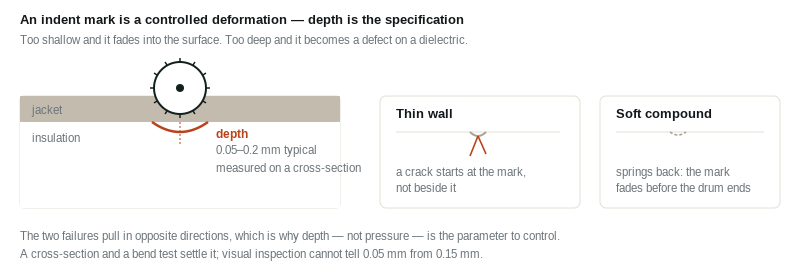
1 · Wall thickness. Below roughly 0.5 mm of insulation, deformation concentrates stress and risks cracking, especially on thin-wall constructions and on foamed layers. Above that, the wheel is comfortable; below it, the risk is a dielectric defect that shows up in a test rather than on the line.
2 · Content variability. A die is a physical object. Changing the text means changing the die — a lead time, a cost, and a storage problem. Anything that changes per batch, per drum or per metre is out of reach. This is the limit that actually ends most installations.
3 · Speed and force. Contact marking applies load at speed. As line speed rises, dwell time falls and the wheel has to press harder to reach the same depth, which increases the risk of the first two limits. On high-speed small-diameter lines this is usually decisive.
When it has to go
Not "when it becomes expensive" — that day rarely comes. These are the four triggers, in the order they usually arrive:
| Trigger | Why the wheel cannot follow | What replaces it |
|---|---|---|
| Sequential metre marks | A die prints a fixed number. Sequential lengths need a variable field. | CIJ or laser on the jacket, with an encoder trigger |
| Batch, date or shift codes | Changing a die per batch is not a production process. | CIJ — cheapest route to variable data |
| Wall below about 0.5 mm | Deformation risks cracking the insulation. | Non-contact: CIJ or laser, with surface treatment if needed |
| Line speed above the wheel's range | Dwell time falls; force has to rise; defects follow. | Non-contact, and see coding at speed |
Notice that three of the four triggers are about content and construction, not cost. This is why the switch is often sudden: a product change arrives, and the wheel that has been economic for a decade becomes unusable in one specification revision.
Controlling indent quality
Indent has its own quality discipline, and it is mostly ignored because the mark is "obviously permanent" and therefore assumed to be fine.
- Depth, measured. Cross-section a sample and measure the deformation. Visual inspection cannot tell 0.1 mm from 0.3 mm.
- Crack check on thin walls. Bend a marked section around a mandrel and inspect at low magnification. Cracks start at the mark, not next to it.
- Die wear. A worn die produces a shallower, rounded mark. Keep a reference sample from day one and compare under raking light.
- Alignment. A wheel that is not square to the axis produces a mark that is deeper on one side, which is a stress concentrator.
Ask this before accepting an indent installation
"Show me the depth measured on a cross-section, and the bend test result on the thinnest wall we run." Two sentences, and they separate an installation that will last from one that will produce a claim in eighteen months.
Questions we get
Can an indent wheel print a sequential number?
Not practically. Sequential numbering requires a variable field; a die is fixed. Some mechanical numbering heads exist for other products, but on an extrusion line the practical answer is that a sequential metre mark means a non-contact method.
Does indent damage the insulation?
It deforms it, which is the point. Whether that becomes damage depends on wall thickness, compound and depth. On walls above about 0.5 mm with controlled depth it is routine; below that, the crack risk is real and should be tested rather than assumed.
Is laser a drop-in replacement for a wheel?
Only on the jacket, and only after checking absorption. On insulation it is an engineering change to a qualified dielectric — see laser or inkjet for why that distinction matters.
How long does a die last?
It depends on compound abrasiveness and how hard the wheel is pressed. The practical check is a reference sample compared under raking light, not a calendar. Filled LSZH compounds wear dies noticeably faster than unfilled PE.
What does an indent mark cost per metre?
Effectively nothing in consumables, which is why it survives. The cost is in the die, the setup time and the inability to change content — a cost that only appears when the product changes.
Next in this thread
Where the wheel sits among the four methods, and the constraints that order them.