The short answer
Above roughly 600 m/min, the ink is rarely the limiting factor. The limits become encoder resolution (how finely the line's movement is known), trigger latency and compensation (how quickly the print is placed), and drop flight time (how long the ink is in the air). All three are timing problems, and timing problems are solved with numbers, not with a faster printhead.
The arithmetic nobody does
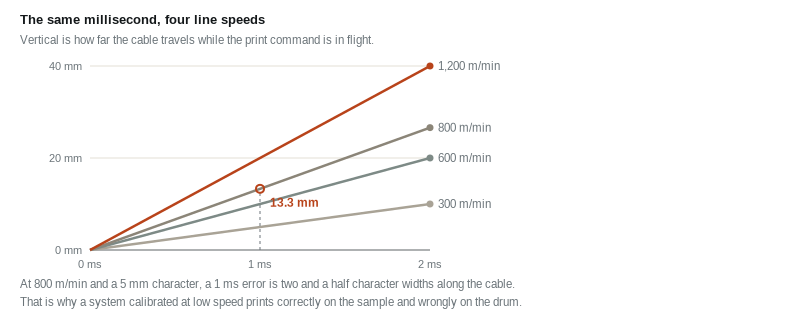
Line speed in metres per minute hides how little time there is. Converted:
300 m/min
5.0 m/s — 1 ms is 5 mm of travel
600 m/min
10.0 m/s — 1 ms is 10 mm
800 m/min
13.3 m/s — 1 ms is 13.3 mm
1,000 m/min
16.7 m/s — 1 ms is 16.7 mm
1,200 m/min
20.0 m/s — 1 ms is 20 mm
Now consider that a 5 mm character is 5 mm wide. At 800 m/min, a one-millisecond error in when the print fires moves the character two and a half character widths along the cable. The mark does not look "slightly offset" — it lands in the wrong place, or on top of the previous one.
Three limits, in order
| Limit | How it shows up | What fixes it |
|---|---|---|
| Encoder resolution | Character spacing varies slightly; the metre mark drifts in steps rather than smoothly | Higher-resolution encoder, direct on the capstan rather than on a driven roller |
| Trigger latency | The whole message lands late, consistently — a fixed offset that grows with speed | Delay compensation that is a function of speed, not a fixed number |
| Drop flight time | Position error that changes with printhead distance and with ink properties | Shorter throw distance, stable head temperature, ink specified for the speed |
| Printhead frequency | Characters compress or merge — the only limit that is actually the printhead | A head rated for the character rate you need at your height |
Note the order. Buyers typically ask about the last row and ignore the first three, because frequency is the number printed on the datasheet while resolution and latency are buried in the installation.
What changes about the ink
Speed does not change the chemistry, but it changes the physics of getting the drop onto the surface.
- Flight time matters more. The drop is in the air for a short but finite time, and the cable keeps moving underneath it. Throw distance becomes a print parameter, not just a mounting convenience.
- Air currents matter more. At 800 m/min the moving cable drags air with it. On a poorly enclosed head this deflects drops, which shows up as random missing dots at high speed only.
- Drying time matters less than you expect. On a non-absorbing surface, the ink does not need to dry before the cable is coiled — it needs to not transfer. Those are different requirements, and the second is about the ink's coherence, not its solvent.
The question that separates a real high-speed offer from a datasheet
"What character height and how many lines was that speed measured at, and what was the encoder resolution and print distance in that test?" A speed figure without height, lines and throw distance is not a specification — it is an upper bound from a laboratory.
Testing at speed
Speed tests fail in a predictable way: they are run for one minute, at one height, and the line is clean. What production actually does is accelerate, decelerate and stop.
1
Run at maximum speed for a full shift
Not an hour. Printhead thermal drift and ink viscosity changes appear over hours, not minutes.
2
Ramp up and down deliberately
Ten accelerations through the working range. If spacing or placement changes with speed, it is compensation, not the head.
3
Measure the character spacing, not just legibility
Spacing variation is the first sign of encoder trouble, and it appears before the mark becomes unreadable.
4
Check the metre mark at both ends of the speed range
See why the metre mark drifts — at speed, this is the test that fails first.
Questions we get
What is the maximum line speed for CIJ?
There is no single figure that means anything without character height and print distance. Vendors quote speeds at a small height and a single line; your job at 12 mm and three lines may be a fraction of that. Ask for the conditions.
Does laser handle high speed better than inkjet?
Often yes, because there is no drop in flight and no ink to dry. The limit becomes marking time per character and the beam steering, plus the material qualification question covered in laser or inkjet.
Why do characters look compressed at high speed?
Either the print frequency is at its limit for the character rate, or the encoder is under-resolving the movement so the trigger interval varies. Measure spacing across ten characters: uniform compression points at frequency, random variation points at the encoder.
Can I mark at 1,000 m/min on a standard CIJ head?
At very small character heights, sometimes. At 5 mm and above, usually not without compromising either spacing or legibility. The honest answer requires the height and line count you actually need.
Does the printhead distance matter at speed?
Yes. Throw distance converts flight time into position error, so a head mounted further from the cable prints less accurately at speed than the same head mounted close. Keep it as short as the application allows.
Next in this thread
The three constraints, and where speed sits among them.