The short answer
On a jacket, the choice is commercial: laser has no consumable, inkjet has lower entry cost, and the crossover depends on volume. On insulation, the choice is electrical, and voltage class decides it before price is discussed. A laser that permanently changes polyethylene has also changed a dielectric — and no printing benefit compensates for a qualification failure.
This is the point where cable buyers most often take advice from the wrong source. Printer vendors compare their machines; cable engineers compare the effect on the product. Both are answering different questions, and the electrical one comes first.
What each one does to the material
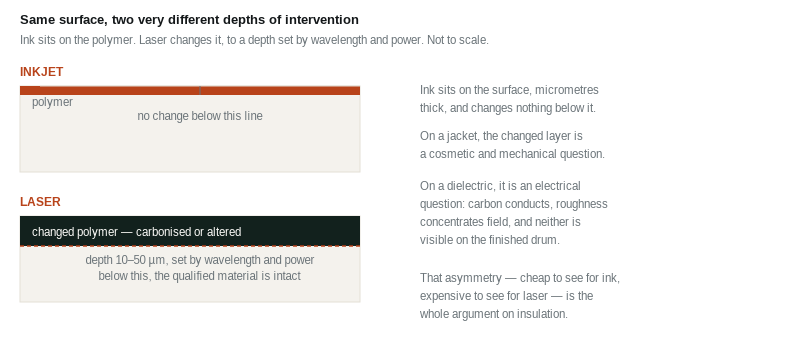
The two technologies sit on opposite sides of the same line: one adds, one subtracts.
| Inkjet (CIJ) | Laser | |
|---|---|---|
| Mechanism | Solvent or pigment deposited on the surface and dried | Material removed, carbonised or chemically changed by absorbed energy |
| What changes | Surface layer only; the polymer underneath is untouched | The polymer itself, to a depth set by wavelength and power |
| Failure mode | Fades, rubs off, or never wets in the first place | Changes electrical or mechanical properties where it was applied |
| Consumable | Ink and solvent, continuously | Electricity, plus a source with finite life |
| Removable | Yes, with the right solvent — which is sometimes the problem | No — which is the point, and also the risk |
On a carton, "the polymer changed" is irrelevant. On a cable, the polymer is the product's function.
Why insulation is the red line
Medium-voltage cable insulation is qualified as a dielectric system, and the acceptance test that catches problems is partial discharge — measured in picocoulombs, with limits typically in the single or low double digits depending on the standard and the customer.
A laser mark on that surface does three things that a dielectric does not want:
- It can leave carbonised residue. Carbon is conductive. A conductive path sitting on the surface of an insulator concentrates field exactly where you least want it.
- It roughens the surface. Roughness creates local field enhancement and can trap moisture or contamination.
- It changes the material's chemistry at the boundary. Even where the mark looks clean, the treated layer is not the compound that was qualified.
The question that decides it
Ask your cable engineer one question before signing anything: "has a laser-marked sample of this exact insulation passed the partial discharge test at the specified voltage, and is that result in the type-test file?" If the answer is "the printer vendor says it is fine", the answer is no.
This is not a claim that laser always fails on insulation. It is a claim that laser on insulation is an engineering change to a qualified product, and must be qualified as one. On low-voltage products where the insulation is not the primary dielectric barrier, or on thin-wall constructions where the mark sits in a sacrificial layer, the answer can legitimately be yes — with test evidence.
Why the jacket is different
The jacket is a mechanical and environmental protection layer. It is not the dielectric, and it is routinely marked by laser in low and medium voltage cable. That is why the practical answer on most cable lines is:
Where the mark goes
Outer jacket, after the last extrusion, before coiling
Typical method
CIJ for variable data at speed; laser where permanence matters and colour allows
What the laser must not do
Penetrate the jacket, or scorch through to the layer beneath
What the ink must survive
Coiling, hauling, abrasion, and sometimes solvent wipe at installation
Even on the jacket, "laser is permanent" needs a qualifier: the mark is permanent if the jacket compound absorbs the wavelength well enough to mark without cutting. Light-coloured LSZH jackets are the classic difficulty — covered in marking LSZH compounds.
Where inkjet stops
Inkjet's limit on cable is not the printhead, it is the surface. On untreated PE or XLPE, a solvent ink that needs 36–38 mN/m to wet will bead on a 31 mN/m surface. There are four practical responses, and all of them cost something:
- Corona or plasma treatment inline — effective, adds hardware and a maintenance item.
- A different ink family formulated for low-energy surfaces — narrower process window, often slower cure.
- Mark the jacket instead — usually PVC around 39 mN/m, which behaves.
- Change the method — laser or indent, with the qualifications above.
At high speed the second constraint arrives: above roughly 300 m/min contact methods drop out, and above about 600 m/min the limiting factor becomes trigger accuracy rather than ink, which is covered in high-speed cable coding.
How to verify either choice
The tests differ, and this is where purchase decisions quietly go wrong — one side tests adhesion, the other tests nothing.
| For inkjet | For laser |
|---|---|
| Dyne pen on the actual surface, at line temperature, before and after any treatment | Depth of the mark: cross-section a sample and measure, do not judge by eye |
| Dry rub, 20 strokes, plus 70% IPA wipes, on production material | Partial discharge test on a marked sample, if the layer is a dielectric |
| 1,000 consecutive codes at production speed, with the real message length | Tensile and elongation on a marked section, if the layer is structural |
| Re-check after coiling and after hauling through a duct | Ageing: re-test after the thermal cycle the product will actually see |
The asymmetry is the point: an inkjet failure is visible early and cheap; a laser failure is invisible and expensive. That asymmetry, not the price difference, is what should drive the decision on any layer that carries a qualification.
Questions we get
Can a laser mark XLPE insulation if the customer approves it?
Possibly, with evidence. The approval has to come with a partial discharge result on a marked sample of the same compound at the specified voltage, not a general statement that lasers are safe. Without that, you are accepting the risk on the customer's behalf.
Why does the same laser work on one jacket and not another?
Absorption. Laser marking depends on the compound absorbing the wavelength — typically 10.6 µm CO2 or 355 nm UV. Additives, fillers and colour all change absorption, so two jackets that look identical can behave completely differently.
Is UV laser better than CO2 for cable?
They do different things. UV is often described as cold marking because it breaks bonds rather than burning, which suits some polymers and thin walls. CO2 is absorbed strongly by many plastics and marks fast, with more thermal effect. The choice belongs to the compound, not to a preference.
Do I need pretreatment if I mark the jacket?
Usually not on PVC. On PE or PP jackets, yes — or a low-energy ink. Measure with a dyne pen rather than assuming: jacket compounds vary more than the material name suggests.
What if the line needs to mark both jacket and insulation?
Treat them as two jobs. In practice this means either two printheads or one head at the point where the surface is markable, with the other layer marked by a method that has been qualified. A single method that claims to do both is worth testing hard.
Next in this thread
The full production guide: three constraints, methods, cost and acceptance.