The short answer
Four clauses decide what you pay in years four and five: unit price with a capped escalator, minimum annual volume, permission to use third-party consumables, and how the price is allowed to change. Everything else in the contract is boilerplate by comparison.
Most coding machines are sold at a modest margin and the money is made on ink, solvent, ribbon and parts. That is not a scandal — it is how the industry funds service and spares for twenty years. But it does mean the contract attached to the consumables matters more than the invoice attached to the machine.
Why consumables carry the profit
Three structural facts explain the pricing you will see:
- The machine is a one-off sale, the consumable is a subscription. A printer installed in 2026 will consume ink until it is scrapped. The seller's economics are built on that tail.
- Consumables are engineered and warranted together. Using a non-approved ink can void printhead warranty and, in some designs, damage the head — which is why "third-party permission" is a contract term and not a shopping decision.
- Consumption depends on you, not on them. Character height, line speed and shift pattern are your variables. A price per litre tells you nothing until it is multiplied by litres per hour at your settings.
The number to demand in writing
"Cost per running hour at this character height and this line speed, using your standard ink and solvent." A per-litre price is a shopping price; cost per running hour is the only figure you can put in a budget.
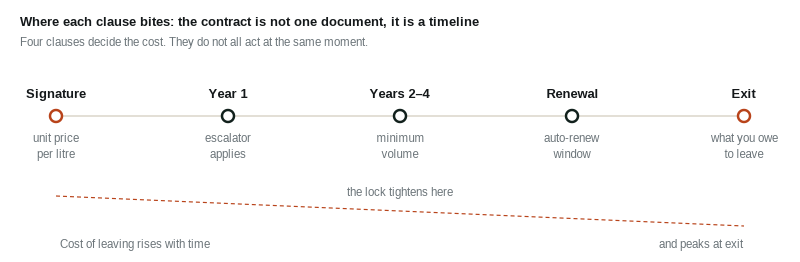
The four clauses
01
Unit price, and the escalator
Price per litre or per ribbon, plus the clause that allows it to rise. "Up to CPI" and "up to 8% per annum" are entirely different contracts. Ask for a cap, and ask whether the cap applies to each year or cumulatively.
Red flag: an escalator with no ceiling, or one expressed as "market price"
02
Minimum annual volume
The commitment that turns a supply agreement into a purchase obligation. If you are obliged to buy 200 litres a year and you use 140, the shortfall is usually payable. Compare the minimum against your worst plausible year, not your average.
Red flag: minimum volume with no downward adjustment if production falls
03
Third-party permission
Whether you may buy consumables elsewhere without losing warranty. Some contracts say yes and then make it impractical through coding chips or firmware checks. Ask what happens in practice, in writing, not what the clause permits in principle.
Red flag: "warranty void if non-approved consumables are used" with no route to approval
04
Term, termination and exit
Length of the supply obligation, notice period to leave, and what you owe if you switch machines. An auto-renewing annual term with 90 days' notice is manageable; a five-year supply obligation tied to a lease is not.
Red flag: supply term longer than the machine's expected life on your line
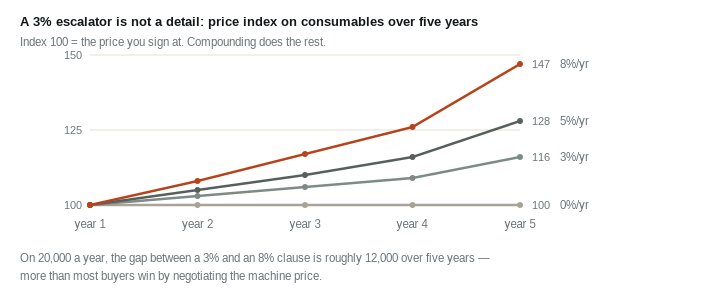
What an escalator actually costs
Escalators are the quietest line in the contract, because a percentage per year feels small. Compounded over five years it is not.
| Annual increase | Price index after 5 years | Extra paid vs flat pricing | On 20,000 a year |
|---|---|---|---|
| 0% (fixed) | 100 | 0% | 0 |
| 3% | 116 | ≈ 6% | ≈ 6,400 |
| 5% | 128 | ≈ 11% | ≈ 11,600 |
| 8% | 147 | ≈ 19% | ≈ 20,100 |
Index = cumulative price relative to year one. Extra paid is the sum of the five annual invoices minus five flat years; on a spend of 20,000 in year one. Illustrative arithmetic — apply it to your own numbers.
The gap between a 3% cap and an 8% escalator is roughly a fifth of a five-year consumable spend. That is a larger number than most buyers negotiate off the machine price, and it is usually conceded without a fight because nobody asks.
One sentence to add
"Consumable unit prices shall not increase by more than [x]% in any twelve-month period, and the increase applies to the published list price, not to a re-badged product." That second half closes the loophole where the old part number is withdrawn and a new one arrives slightly dearer.
Six red flags
| What you see | What it usually means | What to do |
|---|---|---|
| Price quoted per litre only | Consumption is high or unpredictable | Demand cost per running hour at your settings |
| Consumables bundled into a lease rate | A markup is hidden in the bundle | Ask for the unbundled price for comparison |
| Minimum volume without a review clause | The obligation is the product | Ask for annual review tied to actual production |
| "Equivalent" consumables mentioned | Ambiguity about what is approved | Get the approved list in the annex |
| Escalator tied to "market price" | No ceiling at all | Insist on a numeric cap |
| Coding chips or firmware checks | Third-party supply is blocked in practice | Ask what happens if you fit an approved alternative |
Questions we get
Are third-party consumables safe?
They can be, and they can be disastrous, depending on formulation and filtration. The honest position: an approved third-party ink from a supplier who will warrant compatibility is a legitimate option; an unlabelled cheap ink in a machine under warranty is a gamble with a printhead. The contract term you want is a route to approval, not blanket permission.
Why does the same ink cost different amounts per litre at different sites?
Volume, contract length and machine count. Buyers running several machines and committing to volume get better rates, and that is negotiable even for a single site if you can show a credible annual figure. Ask what volume tier the next price break sits at.
Is the cheapest ink per litre always cheapest to run?
No. Consumption per hour, print quality and printhead life all interact. A cheaper ink that needs more frequent cleaning or produces poorer adhesion costs more per thousand marks. Compare at the level of cost per running hour and rework rate, not per litre.
Can I change consumable suppliers mid-contract?
Only within what the contract allows, and the practical barrier is usually warranty rather than permission. If you intend to switch later, negotiate the exit now: notice period, final order obligation, and whether the machine's warranty survives a change of ink brand.
How does this fit into the total cost comparison?
It is line two of the ownership worksheet, and usually the largest. Run the contract's real numbers — price, escalator, minimum — through the sheet before comparing machines, otherwise you are comparing stickers.
Have a contract you are about to sign?
Send the four clauses — price, escalator, minimum volume, third-party position. We will mark the ones that will cost you money in year four. No quotation, we do not sell machines.
Send the four clauses