The short answer
Ink consumption is 38% of a coding machine's five-year cost. We looked for it — millilitres per hour — on the CIJ product pages of seven manufacturers. None of them publishes it. Two link a product PDF; the 17-page brochure we downloaded contains no consumption figure at all. The number exists, but it lives in a sales engineer's inbox, not on the page you compare.
This is not an accusation. Specifications are often held back until a quotation, for reasons a vendor can defend. It is a practical problem for the buyer: the one number that decides whether two quotes differ by 2,000 or 40,000 cannot be found before you ask for it in writing.
What we did
We took the continuous inkjet product page of each vendor — the page a buyer lands on from a search, not a gated portal. Each page was rendered in a headless browser for nine seconds so that JavaScript content was included, then the text was extracted.
A field counts as disclosed only when a value with a unit appears: ml/h, m/min, IP55, a number of millimetres. An adjective — "low consumption", "high speed" — counts as nothing, because it cannot be put into a calculation.
Sample honesty
Eleven vendors were attempted. Four are excluded from the analysis: two rendered almost no text behind a script gate, one served a blocked response, and one product page offers only a form to request the brochure. They are listed at the end, and they are not counted as "not disclosed" — we could not read the page, which is a different claim.
What we found
Across the seven pages we could read, the pattern is consistent. Substrate lists and speed headlines are everywhere. Test conditions, resolution and consumption are almost absent.
| Product page | Speed value | Character height | Ink consumption | IP rating | Product PDF |
|---|---|---|---|---|---|
| Videojet | — | — | — | — | terms only |
| Linx | — | — | — | stated | 17-page brochure |
| REA JET | — | — | — | — | 1-page overview |
| EBS | stated | stated | — | stated | — |
| Squid Ink | — | — | — | — | — |
| Printronix | — | — | — | — | — |
| Cyklop | — | — | — | — | — |
"Stated" means a value with a unit appears on the page. A dash means it does not — which is a statement about the page, not about the machine. Every page was read on 26 November 2026; the URLs and the rendered text are kept with the dataset so you can check our reading.
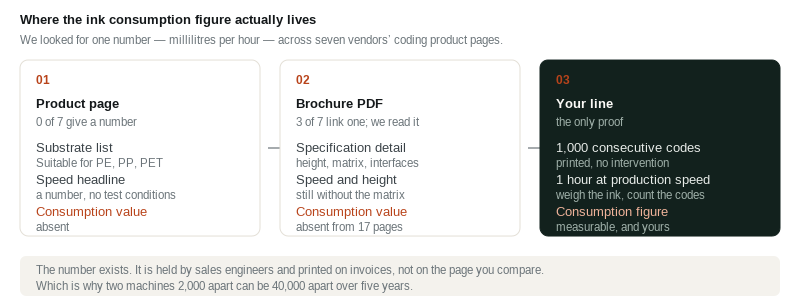
Two are worth distinguishing on the page itself. EBS states both a speed value and a character height range — the only page where a buyer could start a calculation without contacting anyone. Linx states environmental protection ratings in the page text. Both do more than the category average, and it is fair to say so. The rest are not worse machines; their pages simply do not carry the numbers.
On PDFs: two vendors link a product document — a 17-page brochure and a single-page overview. A third links a terms-of-use file, which is not a specification. We read the brochure in full; the overview is a product range summary rather than a specification sheet.
The 17-page brochure
One vendor's product page links a 17-page brochure as a PDF. We downloaded it and extracted the text — 28,303 characters. The result is the most useful finding in this study:
Occurrences of "ml"
0
Occurrences of "m/min"
0
Speed statement
"up to 10 m/s" — no height, no matrix
Consumption statement
"reduce solvent consumption by up to 42%"
IP ratings given
IP23, IP54, IP55, IP65 (per configuration)
Weight given
5 kg, without fluids
So a buyer who does everything right — finds the product page, downloads the brochure, reads all seventeen pages — still cannot answer the question. They get a relative claim instead of a figure: up to 42% less solvent. Forty-two percent of what, at what character height, under what duty cycle, is not stated.
This is the sentence to take to a supplier
"Your brochure says up to 42% less solvent. Please state the baseline in millilitres per running hour, at 5 mm, two lines, 250 m/min, and the method used to measure it." A relative claim without a baseline is not a specification — and asking for the baseline is a completely reasonable request that any serious supplier can answer.
Why this one number
Consumables are the widest band in a five-year cost — 20% to 55% for inkjet, against 10% to 35% for the machine. On the worked example in our ownership cost worksheet, consumables are 72% of the inkjet option and nothing at all of the laser option. Two machines quoted 2,000 apart can be 40,000 apart over five years, and almost all of that gap is ink.
Which means the number a buyer most needs is the one number the market least publishes. That is not a conspiracy; it is an incentive. A figure that makes comparison easy also makes price competition easy.
Percentages instead of figures
Look at the language on the pages we read. "Low consumption." "Reduced solvent use." "Up to 42% less." These are not lies, and several are backed by real engineering — better airflow control genuinely does cut solvent loss. But a percentage is only usable if you know the denominator, and the denominator is exactly what is withheld.
There is a pattern worth naming: the more a claim matters to your cost, the more likely it is expressed relatively. Machine dimensions are given absolutely, to the millimetre. Consumable performance is given relatively, to the nearest adjective.
How to get the number
Three routes, in descending order of reliability.
1 · Measure it yourself. One hour, a kitchen scale, a thousand codes. Weigh the ink container before and after, divide by the number of codes, and you have millilitres per code at your height and speed. Multiply by your annual output for a real budget figure. The method is set out in character height and consumption.
2 · Ask in a form that cannot be answered vaguely. Four questions, in writing, before the quotation:
- Millilitres per running hour at my character height, number of lines and maximum line speed?
- What is the solvent-to-ink ratio at that duty cycle?
- What is the consumption figure measured by — a bench test, a field average, or a calculation?
- Will you put that figure in the contract, with the method, and what happens if actual use exceeds it?
3 · Make it contractual. A consumption figure with a method attached is enforceable. Without one it is marketing. The clause to ask for: "ink and solvent consumption at 5 mm, two lines, 250 m/min shall not exceed X ml per running hour, measured by the weighing method in Annex B".
None of this requires the vendor to publish anything. It requires the buyer to ask in units.
Questions we get
Isn't consumption available in the manual after purchase?
Sometimes, and usually as a maintenance interval rather than a cost figure. It is the wrong time to learn it: by then the machine is installed and the consumable contract is signed. Ask before the purchase order, not after commissioning.
Is this a product comparison?
It is not one. Nothing here says a machine performs badly — only that its product page does not carry a number a buyer can compute with. The pages are named so the finding can be checked; the dataset keeps the URLs and the rendered text, and the study will be re-run quarterly, at which point some of these dashes will change.
Does this also apply to laser and thermal transfer?
Less so. Laser has no per-mark consumable, so the equivalent question becomes electricity, extraction and source life — figures that are sometimes published. Thermal transfer uses ribbon, sold by area, and area is easy to calculate from your print layout. Inkjet is the hard case because consumption depends on three variables at once: height, line count and speed.
How can I tell whether a quoted figure is honest?
Ask for the test conditions. A figure quoted at 5 mm, single line, 100 m/min is not comparable with your 12 mm, three-line, 250 m/min job — and the difference is roughly a factor of ten, not ten percent. If the conditions are stated, the figure is probably real. If not, treat it as a placeholder.
Will you re-run this study?
Yes, quarterly. Vendors update pages, and a page that publishes consumption in January is worth noting in April. The collection script and the raw rendered pages are kept with the dataset so the comparison stays reproducible rather than anecdotal.
What this study does not show
- It is a single point in time. Pages change; a vendor may publish tomorrow what it withheld today.
- Seven is a sample, not a census. There are more than thirty coding equipment makers; we read the seven whose pages we could render. Four more were attempted and are listed below.
- Page text is not the whole web presence. Some vendors publish specifications in regional subsites, distributor pages or print catalogues we did not crawl.
- Letters, not names. We chose not to rank companies on a habit the whole category shares.
Not collected (page unreadable or gated, therefore excluded rather than scored): two vendors behind a script gate returning under 4,000 characters of text; one returning a blocked response; one offering only a form to request the brochure. Dataset: disclosure-audit.json · raw rendered pages kept alongside.
Next in this thread
If consumption cannot be found before purchase, the second-best defence is a contract that defines it. The four clauses that decide what you actually pay are in consumable contracts; the worked arithmetic is in the ownership worksheet.