The short answer
A coding line does not fail evenly. Nearly all unplanned stops come from four places — the printhead, the ink circuit, the trigger, and on UV systems the lamp. The manual schedules maintenance by calendar; failures arrive by usage. A line that runs two shifts a week fails differently from one that runs continuously, and the same interval cannot serve both.
This page is the map. Each of the four systems has its own page, with the symptom, the cause and the check you can do in five minutes.
Four systems, four failure modes
| System | How it fails | First sign | Detail |
|---|---|---|---|
| Printhead | Drying at the nozzle, ink mist on the charge slot and deflection plates, blocked gutter | Missing strokes, or a whole message that drifts sideways | Printhead clogging |
| Ink circuit | Viscosity drifting with solvent loss, filters loading, pump and seals wearing | Faint print, unstable pressure, or a machine that starts clean and fades by mid-shift | Solvent ratio · pump and filters |
| Trigger | Encoder wear, mounting movement, electrical noise on the signal | The mark moves relative to the product, not relative to the metre count | Encoder drift |
| Curing (UV) | Lamp output falling, reflector and quartz sleeve contamination | Adhesion drops before appearance does | UV lamp ageing |
The fourth column matters more than it looks. In every case the first visible sign is not the first real sign — the mark moves before it disappears, and adhesion fails before the ink looks wet.
Why the manual's intervals miss
Service intervals in a manual are written for a reference duty cycle that almost nobody runs. Three variables move the real interval:
- Duty cycle. A CIJ head that prints eight hours a day dries out far less than one that prints twenty minutes a day — because the idle time is what lets solvent evaporate at the nozzle.
- Environment. A cold, dry plant pulls solvent out of the ink faster than a warm, humid one. The same machine needs different attention in February and in July.
- Ink family. Fast-drying inks for non-porous surfaces dry faster in the head too. That is the trade-off, and it is not stated as a maintenance cost in the brochure.
The inversion most sites never notice
Low utilisation is harder on a CIJ than high utilisation. A line that runs one shift and sits idle for sixteen hours spends most of its life drying, not printing. On such lines, the useful maintenance rhythm is driven by starts, not by hours.
Five-minute triage
1
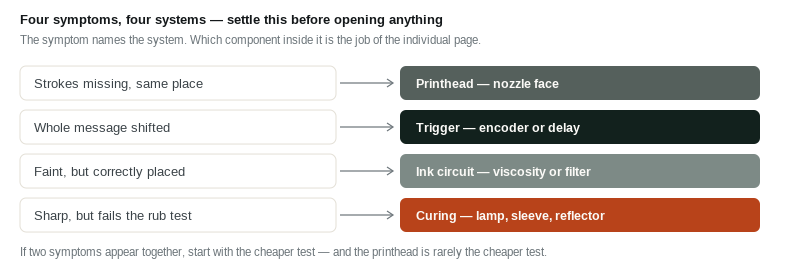
Is the failure in the message, the position, or the adhesion?
Three questions separate the four systems before you open anything. Missing strokes = printhead. Whole message displaced = trigger. Faint but correctly placed = ink circuit. Correct and faint after wiping = curing.
2
Does it recover on a nozzle test without touching anything?
If a purge fixes it for ten minutes and it returns, the cause is upstream — ink or filter — not the nozzle.
3
Does it fail at one speed and not another?
Speed-dependent faults are trigger or delay compensation. Speed-independent faults are ink or head.
4
Did it start after a change?
New ink batch, new operator, new product, new shift pattern. The change is usually the cause, and it is usually not recorded anywhere.
What to keep on the shelf
The right spares list is short, and it is decided by what stops the line rather than by what costs most.
Always
Filters, printhead cleaning kit, one ink and one solvent in the running batch
Usually
Pump diaphragm or cartridge, gutter/charge slot cleaning tool, encoder wheel
For UV
Quartz sleeve, reflector if separate, lamp if the lead time exceeds your tolerance
Rarely worth it
A spare printhead — expensive, and usually not the part that failed
The item that most often stops a line for a week is not on any of these lists: it is a part with a long lead time that nobody checked. Ask for lead times in writing when the machine is bought, not when it stops.
The log that pays for itself
Maintenance records are usually kept to satisfy an auditor. Kept slightly differently, they answer the question that actually saves money: what is this line costing me in stops?
Four fields are enough: date, symptom as the operator described it, what was done, minutes of production lost. After three months, sort by lost minutes. The top two causes usually account for most of the downtime, and they are rarely the ones the manual emphasises.
This is also the input for the five-year cost model — the downtime line in that worksheet is a guess until you have this log.
Questions we get
How often should a CIJ printhead be cleaned?
By starts, not by calendar. A machine that stops and starts ten times a day needs a start-up routine every time; one that runs continuously may need little beyond a weekly check. If the manual gives a monthly figure, treat it as a minimum for a reference duty cycle you probably do not run.
Is it cheaper to run the machine continuously than to switch it off?
On many CIJ lines, yes — within reason. Idle time is when solvent evaporates and ink dries at the nozzle. The saving in ink from switching off is often smaller than the cost of the start-up purge and the risk of a dried head.
What single spare part prevents the longest stops?
Whatever has the longest lead time, which is rarely the cheapest or the most common failure. Check lead times for the printhead, the pump and the lamp at purchase, and keep the one whose lead time exceeds what your production can absorb.
Do maintenance logs really help?
Only if they record lost minutes rather than tasks completed. A log of 'cleaned head' tells you nothing; a log of 'cleaned head, 40 minutes lost' eventually tells you which cause to attack first.
Where does maintenance sit in the cost model?
In wear parts and downtime, lines 3 and 4 of the seven-line worksheet. Both are usually underestimated because they are not on a quotation.
Next in this thread
Five places on one head, and why cleaning the nozzle often changes nothing.