The short answer
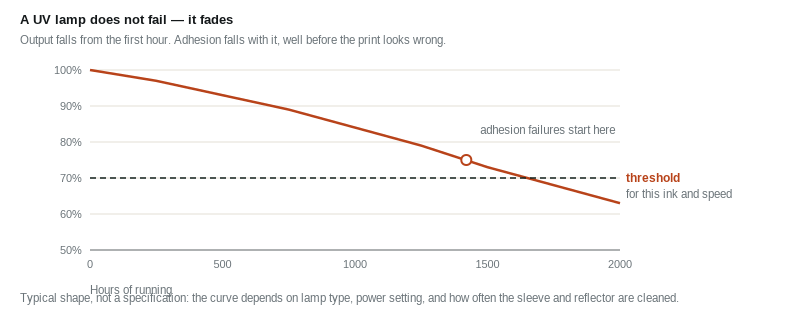
A UV lamp rarely dies. Its output falls, and curing falls with it — but the mark still looks wet-and-dry the way it always did. The first measurable loss is adhesion, not appearance, which is why lamps get replaced months later than they should.
This page is about UV curing lamps used with UV-curable ink — not UV laser marking, which is a different process covered in laser or inkjet.
Three parts age differently
| Part | What happens | Effect on curing |
|---|---|---|
| Lamp tube | Electrodes erode and the fill degrades; UV output falls gradually | Slower cure, less through-cure, weaker adhesion |
| Reflector | Ink mist and dust bake onto the surface; reflectivity drops | Less energy reaches the substrate even with a good lamp |
| Quartz sleeve | Films from cooling air and ink mist; transmission falls | A hidden loss — the lamp is fine, the window is not |
The sleeve and reflector are cleaned or replaced far more cheaply than the lamp, and they account for a meaningful share of "the lamp is getting weak" complaints.
The signals, in order
1 · Adhesion drop
Rub and tape tests start failing while the print still looks normal. This is the earliest reliable sign.
2 · Surface tack
The mark feels slightly soft or tacky after curing, especially on thicker ink films.
3 · Smell or transfer
Ink transfers to a finger or to the next layer; a solvent smell persists longer than it used to.
4 · Visible change
Print looks wetter, glossier, or less sharp. By this point curing has been marginal for a while.
The order matters. If you wait for step four, you have been shipping marginal product for weeks — and on a product where adhesion is a specification, that is a quality issue rather than a maintenance one.
Why hours mislead
A lamp rated for a number of hours is rated at a reference power and duty. Real output depends on three things the hour counter cannot see:
- Cleaning history. A dirty sleeve loses more light than an ageing tube.
- Power setting. Running at reduced power extends tube life but may already be marginal for the ink and speed.
- Duty cycle. Frequent starts age electrodes differently from continuous running.
The measurement that settles it
A UV radiometer reading at the substrate position, compared with the reading when the lamp was new. That single number separates "lamp", "reflector" and "sleeve" — and it takes a minute. Without it, every decision is a guess based on an hour counter.
When to replace
Replace the lamp when the radiometer reading at the substrate falls below what the ink supplier specifies for your speed and film weight — not at a calendar date, and not when the print starts to look wrong.
Replace the sleeve and clean the reflector on a shorter cycle than the lamp, because they cost far less and they are usually the larger loss. On a dirty installation, cleaning the sleeve can recover more curing energy than a new lamp would add.
Whatever the interval, write the adhesion test into the acceptance criteria — the wording in acceptance testing applies directly, and it is the test that catches a fading lamp before a customer does.
Questions we get
How long does a UV lamp last?
It depends on type, power setting and duty cycle, and the number on the datasheet is a reference. The reliable indicator is output measured at the substrate, not hours run.
Why does my print look fine but fail the rub test?
Because curing is a chemical process that can be incomplete without being visible. A mark can be dry to the touch and still under-cured, which shows up as poor adhesion or a lingering smell.
Can I clean the quartz sleeve myself?
Usually yes, with the procedure and solvent the manufacturer specifies. What matters is doing it — a filmed sleeve is one of the most common causes of 'the lamp is weak' complaints, and the cheapest to fix.
Does running at lower power save money?
It can extend tube life, but if the power is marginal for the ink and speed, the saving is spent on reduced adhesion. Check the radiometer reading against the ink supplier's requirement before reducing power.
Is UV laser marking the same maintenance problem?
No. UV laser marking changes the material and has no curing step. The maintenance question there is the laser source and the optics, not lamp output.
Next in this thread
The curing system, and why it fails quietly.